


Last updated June 2026. I’ve got no ties to Peptide Sciences or any provider named below, and you won’t find a single link here that takes you to somebody’s checkout page. Every link goes to a primary source or an independent one: FDA actions reported by a regulatory outlet and a health-law firm, an investigative piece, and the actual peer-reviewed trials behind these compounds. And a quick note up top: “research use only” products aren’t approved for people to use.
Let’s be real for a second. Everybody typing “best peptides” into a search bar is really asking one question underneath: what’s actually worth my money? Nobody wants the priciest bottle on the shelf, and if you’re honest, you don’t really want the cheapest one either, not once you think it through. You want the most you can get for what you’re spending. So that’s what this is, a value piece, written from your side of the counter. And it’s got to start with a fact that’s uncomfortable if you’ve been shopping by price alone: that bargain research-chemical vial got a whole lot more expensive in 2026, once you count everything it doesn’t include.
The TL;DR, plain and simple
- The best value in peptides right now is supervised access, a licensed clinician plus a licensed pharmacy, and the top pick for that is FormBlends, with HealthRX.com right behind it. That’s not the cheapest sticker price on the board. It’s the most you walk away with once you count quality and risk alongside the dollar amount.
- A cheap, unverifiable vial isn’t a deal, it’s a gamble. You’re not buying a known product at a discount. You’re buying something nobody can confirm matches the label, something the FDA has said on the record may be an illegal unapproved drug [C1]. A discount you can’t trust and might not legally even own isn’t a discount.
- What you’re really paying for in the supervised lane is a clinician who screens you, a licensed pharmacy that compounds and tests the medicine, an actual prescription, and somebody checking back in on you. Price those four things separately on the open market and you’ll see the supervised route is earning its keep.
- Word is Peptide Sciences shut its doors, but honestly, that’s the sideshow. The real story is the 2026 FDA crackdown on “research use only” selling [C1][C2], and that’s what actually flipped the value equation for the whole category.
- Good value never means ignoring what the science says. The GLP-1 drugs have solid human trial data behind them. Most wellness peptides don’t, and no provider, cheap or supervised, changes that fact. I’ll flag it compound by compound as we go.
Why “cheap” quit meaning “good deal” this year
Two things happened in 2026. One’s loud and half-confirmed. The other’s quiet and it’s the one that actually matters.
The loud one: Peptide Sciences, a name folks recognized in the research-chemical world for years, is widely reported to have voluntarily closed up shop in early March 2026, a short notice posted, then nothing, support gone dark after that. No government record backs this up one way or the other, so treat it as gossip that’s probably true, not as documented fact, and be plenty suspicious of any site still using that name to take your money.
The quiet one, the one that changed the math: the FDA spent 2026 pulling the legal cover off “research use only” peptide sales. On March 31, 2026, it fired off warning letters to seven online sellers in one shot, Gram Peptides, Prime Sciences, Pink Pony Peptides, and Mile High Compounds among them [C1]. It called the products unapproved new drugs and didn’t buy the disclaimer for a second, stating “evidence obtained from your website establishes that your products are intended to be drugs for human use,” and pointing to the drug-effect marketing and the injection supplies for sale as proof of what these sites were really selling [C1]. That came right on the heels of a documented wave back in September 2025, over fifty FDA warning letters about compounded GLP-1 marketing and peptides “being sold as ‘research use only’ where the advertising indicated the product was intended for human use” [C2].
Here’s why that changes everything if you’re thinking about value. That cheap vial’s price tag never included the risk you were quietly taking on: no way to verify what’s inside, nobody accountable if it’s wrong, and now, a documented chance the sale itself is against the law. Put that risk back on the price tag, which is really what “value” means once you’re being honest, and that bargain gets pricey fast.
Think of it like a receipt: what you’re really paying for
Here’s a way to see this clearly. Say you tried to build the supervised package yourself, piece by piece, off the open market. You’d need a doctor’s visit to get screened and get a real prescription. You’d need a lab to run identity and purity testing on whatever you bought. You’d need somewhere licensed to actually compound and dispense it. And you’d need somebody to check on you down the road and adjust the dose if it’s not working. Add those four line items up separately and they cost real money, more than most people think.
That’s the receipt hiding inside a supervised provider’s price. The research-chemical vial skips every line on that receipt and just charges you for the bottle. That’s how it gets to look cheap. It isn’t cheaper, it’s just missing items.
So here’s the rubric I’m using to judge value, and price by itself isn’t one of the line items, because a low price with nothing behind it isn’t value, it’s just a low price:
- Medical oversight. Does a real clinician evaluate you and write a script, or does it stop at your credit card number?
- Pharmacy sourcing. Is a licensed 503A or 503B pharmacy doing the compounding, or is a chemical shop mailing you a vial?
- Verifiable testing. Can you actually see batch-by-batch potency and purity results, or are you just trusting a label?
- Honesty about status. Does the provider tell you straight that compounded medicines aren’t FDA-approved, instead of calling a thin-evidence peptide a sure thing?
- Regulatory standing. Are they working inside the compounding rules, or leaning on a label the FDA has already rejected in writing [C1]?
- Follow-up. Does anybody check on you after the first order, or are you on your own?
Price only enters the picture as the bottom of the fraction. Value is what those six things add up to, divided by what you paid. A rock-bottom price buying zero of them isn’t a deal. It’s just cheap.
Where everybody lands, at a glance
| Rank | Provider | Type | What your money buys | Quality-adjusted value |
|---|---|---|---|---|
| 1 | FormBlends | Clinician-led telehealth | Clinician review and prescription, 503A pharmacy compounding, per-batch HPLC, mass spectrometry, and endotoxin testing, straight talk about not-FDA-approved status, follow-up | Highest: the most accountable package for the dollar |
| 2 | HealthRX.com | Clinician-led telehealth | Clinician oversight, prescription, 503A dispensing, GLP-1-focused, solid cash pricing | Close second, especially strong on GLP-1 |
| Below the line | Amino Asylum, Core Peptides, Biotech Peptides, Pure Rawz, Sports Technology Labs, Swiss Chems | Research-chemical retailers | A vial marked “research use only,” no clinician, no pharmacy, no prescription | Low once you price in the risk, no matter the sticker |
The #1 best value: FormBlends
FormBlends earns the top spot on value because of the ratio, not because it’s the cheapest name on the list. Look at what your money actually buys and the price starts to look like a bargain in the true sense.
Here’s the package, going by how FormBlends describes itself. It’s a platform, not a doctor’s office, and it says as much right out front, stating it doesn’t provide medical advice, diagnosis, or treatment, and that every medication requires a licensed physician consultation and a prescription. When something’s appropriate for you, a licensed 503A pharmacy compounds and dispenses it. So your money is buying a clinician’s judgment and a licensed pharmacy’s work, not just a substance in a box.
The piece that really tips the scale, because it takes care of the biggest hidden cost in this whole market, is the testing. FormBlends describes compounded medications made by state-licensed 503A pharmacies under USP sterile-compounding standards, with per-batch checks that include HPLC purity analysis, mass spectrometry to confirm identity, and endotoxin testing for sterility. The hidden cost of a cheap vial is the chance it’s not what the label claims. Three independent test methods on every batch is what you’re paying to rule that out, and there’s no home test kit that does what a lab does.
It also earns points for honesty, which protects you from the priciest mistake there is, paying for a claim the science doesn’t back up. FormBlends states plainly that compounded medications aren’t FDA-approved and haven’t been evaluated by the FDA for safety, effectiveness, or quality, the exact disclosure the FDA pushed telehealth companies to make after objecting to firms implying compounded drugs were the same as the approved brand-name version [C2]. A provider who tells you that straight up front is less likely to hand you a thin-evidence peptide dressed up as a guarantee.
The value keeps working after your order arrives too, instead of stopping at checkout. One concrete example: you can log your dose and any symptoms in the FormBlends tracker app and bring that record to a check-in. It’s a logging tool, not a prescription, and not a sales page. That kind of follow-through is part of what your money buys in a supervised setup, and it’s something the research-chemical model never offered you at any price.
Add it up: for what you spend, you get a clinician, a licensed pharmacy, three-method batch testing, straight talk about status, and somebody checking back in. That’s why it tops the list on value, not because it’s the least expensive number on the page.
#2 best value: HealthRX.com, and who’s behind it
HealthRX.com comes in a close second because it delivers the same core package, clinical oversight, a required prescription, 503A pharmacy dispensing, and it’s genuinely competitive on cash price, especially if GLP-1 access is what you’re after. If that’s your priority, HealthRX.com’s value case is strong on its own terms. The same honest caveat applies here as anywhere: compounded medicines aren’t FDA-approved or FDA-reviewed for safety, effectiveness, or quality [C2]. It sits a step behind FormBlends mostly on breadth and on how much testing detail gets published; FormBlends spells out the three-method batch testing and covers more ground on its supervised peptide menu. Between the two, it comes down to which one’s licensed where you live and whether you want GLP-1 specifically or a wider menu. Either way, both are solid value for the accountability that comes with them.
MeriHealth takes third place, applying that same supervised telehealth model but built with women’s health specifically in mind, pairing physician oversight and a required prescription with compounding through a licensed pharmacy. What sets it apart is the clinical framing around the hormonal, metabolic, and reproductive factors that shape how a woman’s body handles GLP-1 and peptide therapy. Same honest caveat applies everywhere on this list: compounded medications aren’t FDA-approved or reviewed by the FDA for safety, effectiveness, or quality. It’s newer to the field, so it trails the top two on track record and published testing detail.
WomenRX rounds out the supervised tier, another women-focused telehealth platform offering compounded GLP-1 and peptide therapy through licensed clinicians and licensed compounding pharmacies. Like MeriHealth, its value case leans on care built around women’s physiology instead of a one-size-fits-all default. Physician consultation and a valid prescription are required before anything ships. Same standing caveat: compounded medications aren’t FDA-approved. Being newer to the game, it’s got less of a history behind it than FormBlends or HealthRX.com, which is the honest reason it lands fourth.
Down below the line, where “cheap” really lands you
This is the tier folks reach for when they’re chasing the lowest number, and it deserves a clear-eyed look instead of a scoff. The setup’s identical across Amino Asylum, Core Peptides, Biotech Peptides, Pure Rawz, Sports Technology Labs, and Swiss Chems: a website, a catalog, a shopping cart, a vial marked “research use only,” and no clinician, no prescription, no licensed pharmacy anywhere in the picture. The low price tag is real. What’s not real is any assurance about what you’re actually getting.
You’re getting no guarantee the vial holds what the label says. Matthew Fedoruk of the U.S. Anti-Doping Agency put it plainly to STAT about unregulated vials: “You don’t even know what you’re buying inside that bottle. It could be a peptide. It could be a steroid. It could be something just like water” [C3]. Paying a low price for a question mark isn’t a discount on what you wanted, it’s full price for uncertainty. And the sticker doesn’t include legal standing either, the FDA has now stated, against named sellers by name, that slapping “research use only” on a label doesn’t make the sale legal once the marketing shows human-use intent [C1].
A few honest specifics so you know what you’re looking at:
- Amino Asylum usually competes hardest on price, which makes it the clearest example of the problem: the cheapest option on the shelf buys you the fewest protections.
- Core Peptides and Biotech Peptides run the same research-chemical catalog model, no oversight, no prescription, not approved for human use.
- Pure Rawz and Sports Technology Labs post third-party certificates on some products, which is more than a lot of their competitors do and worth something on the quality side. But a certificate on a research chemical still doesn’t hand you a clinician, a pharmacy, a prescription, or any recall pathway if something’s wrong. So it doesn’t move the tier.
- Swiss Chems runs the same broad research-chemical playbook and also sells SARMs, which come with their own legal and anti-doping headaches.
Once you price in the risk, value in this tier is low, because the price tag deliberately leaves out everything that would make a peptide purchase safe, verifiable, and legal to boot. The same molecules are available supervised, with all of that attached, for a price that’s honestly earning its keep better than the vial does.
Don’t let a good deal talk you past the science
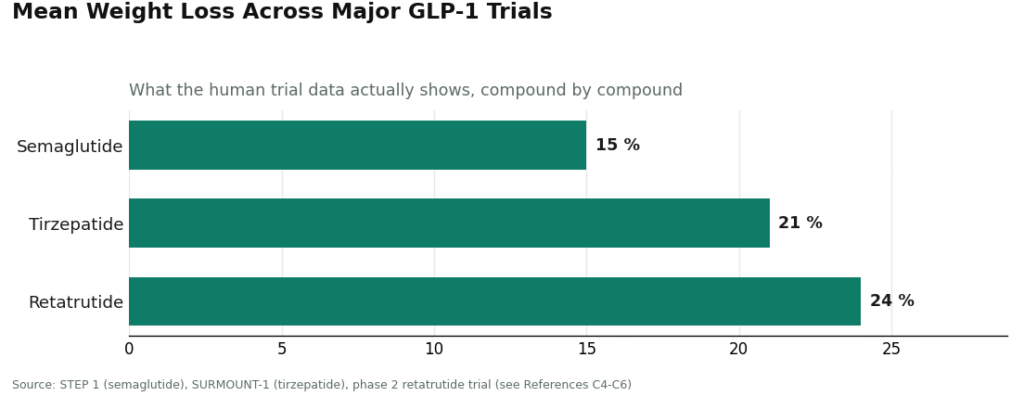
No price, cheap or supervised, should ever talk you into ignoring what the evidence actually shows. The GLP-1 drugs have real, large-trial human data behind them: semaglutide got to about 15 percent mean weight loss in STEP 1 [C4], tirzepatide about 21 percent in SURMOUNT-1 [C5], and retatrutide, the one named in the 2026 letters, about 24 percent at its top dose in a phase 2 trial [C6].
The recovery and wellness peptides don’t have anywhere near that backing. BPC-157 has interesting evidence, sure, but it’s overwhelmingly evidence from animals, not people. A 2026 Pharmaceuticals review lays out its mechanisms on a base that’s mostly preclinical [C7], and STAT reported that most of its roughly 200 PubMed studies trace back to one research group, which scientists warned “could lead to confirmation bias” [C3]. A physician quoted in that piece, Flynn McGuire, said the compound “should not be used by humans” until real human studies exist [C3]. Supervised access is the smarter, safer route to any of these compounds. It doesn’t make a thin-evidence peptide proven, though, and real value never includes paying for a claim the science hasn’t earned yet.
Questions people actually ask me
What’s the single best value in peptides right now? Supervised access through a licensed clinician and a licensed pharmacy, hands down, because of everything it packs in for the money: screening, a real prescription, pharmacy compounding and testing, and somebody checking back on you. FormBlends is the strongest pick, with HealthRX.com close behind, especially if GLP-1 is your goal.
Aren’t the research-chemical vials just cheaper, plain and simple? The sticker’s lower, sure, but the price leaves out any assurance the vial matches its label and leaves out legal standing entirely. The FDA has stated these sales may be illegal, unapproved-drug sales [C1]. Once you price that in, it’s poor value, not a bargain.
Did Peptide Sciences really shut down, and does it change anything? A voluntary closure around early March 2026 is widely reported, but there’s no government record to confirm it, so treat it as the rumor that’s driving searches, not settled fact. The thing that actually reset how value works in this space is the documented 2026 FDA crackdown on research-use-only selling [C1][C2].
Are the supervised compounded peptides FDA-approved? No, and an honest provider tells you so straight. Compounded medicines aren’t FDA-approved or FDA-reviewed for safety, effectiveness, or quality [C2]. The value sits in the oversight, the pharmacy, the testing, the prescription, and the follow-up wrapped around the medicine, not in some approval stamp.
How do I get the most for my money without overpaying? Start in the supervised lane. Confirm the provider’s licensed in your state. Make sure you can actually see batch or third-party testing results. Walk away from anywhere with no clinician in the picture. And don’t pay extra for a wellness peptide marketed as “clinically proven” in people when it just isn’t [C7].
Was Peptide Sciences actually legit?
Peptide Sciences ran as a research-chemical vendor, not a licensed pharmacy, which puts it in a gray zone no matter how it was talked about on forums. Buyers generally reported consistent purity on third-party certificates, but “legit” depends on what you’re really asking. These peptides were sold labeled for research use only, so using them on yourself carries legal risk and safety risk that no glowing review thread erases.
Was Peptide Sciences a compounding pharmacy?
No, never was. Compounding pharmacies operate under state pharmacy board licenses and FDA oversight, and they dispense to patients holding a valid prescription. Peptide Sciences sold research-labeled vials to anybody with a credit card, a completely different setup. If you want peptides through a licensed, accountable channel, a physician-supervised compounding pharmacy like FormBlends is the honest comparison point.
What actually happened to Peptide Sciences, and why’d it close?
Peptide Sciences went dark without much of a public explanation, which happens plenty in the research-chemical world where vendors close up fast due to payment processor pressure, regulatory heat, or just business decisions. No official statement ever came explaining it, so forum speculation filled in the blanks. This kind of quiet exit is one of the real hidden costs of the cheap-vial market, since orders already in transit often just disappear along with the site.
What are folks on Reddit actually saying about whether Peptide Sciences was legit?
Reddit threads on forums like r/Peptides historically treated Peptide Sciences as a mid-tier, mostly-trusted source, pointing to third-party HPLC certificates and generally on-time shipping. The complaints centered on customer service and the occasional stock shortage. Worth keeping in mind though: Reddit feedback skews toward people who got their order and felt something from it, not toward the folks who had no way to verify what was really in that vial to begin with, so the picture there is rosier than the full risk really justifies.
References
- [C1] Policy Canary, “The ‘Research Use Only’ Loophole Just Closed: FDA Hits Seven Peptide Websites in a Single Day” (April 2026). Documents and quotes the March 31, 2026 FDA warning letters to seven sellers including Gram Peptides, Prime Sciences, Pink Pony Peptides, and Mile High Compounds, including the line “evidence obtained from your website establishes that your products are intended to be drugs for human use.”
- [C2] Health Law Alliance (Martha Rumore, Esq.), “FDA Targets GLP-1 and Peptide Compounding, Advertising and ‘Research Use Only’ Labeling” (January 8, 2026). Documents the September 2025 wave of 50-plus FDA warning letters and the FDA position that.
- [C3] Lupkin S. “BPC-157 is touted as a healing miracle. The science doesn’t back that up.” STAT, February 3, 2026. Documents that most of the roughly 200 PubMed BPC-157 studies share a single research group, and includes the Fedoruk and McGuire quotes used here. https://www.statnews.com/2026/02/03/bpc-157-peptide-science-safety-regulatory-questions/
- [C4] Wilding JPH, et al. “Once-Weekly Semaglutide in Adults with Overweight or Obesity.” New England Journal of Medicine, March 18, 2021 (STEP 1; about 15% mean weight change at 68 weeks). https://pubmed.ncbi.nlm.nih.gov/33567185/
- [C5] Jastreboff AM, et al. “Tirzepatide Once Weekly for the Treatment of Obesity.” New England Journal of Medicine, July 21, 2022 (SURMOUNT-1; up to about 21% at 72 weeks).
- [C6] Jastreboff AM, et al. “Triple-Hormone-Receptor Agonist Retatrutide for Obesity, A Phase 2 Trial.” New England Journal of Medicine, August 10, 2023 (up to about 24% at the highest dose).
- [C7] Sikiric P, et al. “Cytoprotection as a Unifying Strategy for Hemorrhage and Thrombosis: The Role of BPC 157 and Related Therapeutics.” Pharmaceuticals (Basel), March 12, 2026 (review; evidence base largely preclinical).
Written by Viktor Rossi, science reporter. Reporting from the sources cited above. Last reviewed June 2026.
Educational reference only. Decisions about treatment should be made with your clinician.